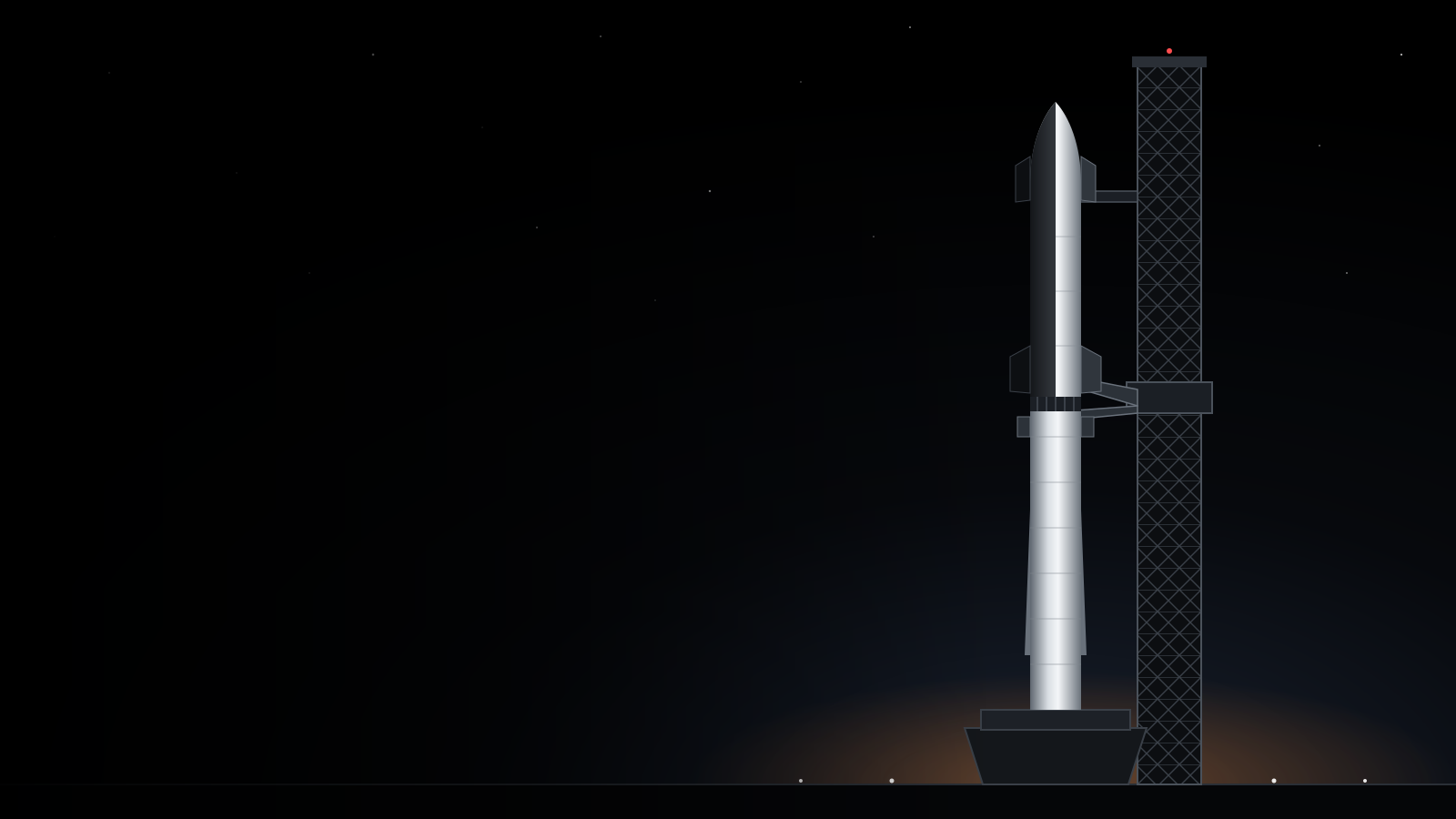
Starship V3 vs. V4
V3 is the Starship flying today. V4 is the bigger version SpaceX plans to fly in 2027. Here is what is confirmed, what is still a goal, and what has not been announced.
V3 and V4 compared
| Starship V3 | Starship V4 | V4 status | |
|---|---|---|---|
| Status | Flying now (since Flight 12, May 2026) | In development | Confirmed |
| First flight | May 22, 2026 (Flight 12) | Targeted for 2027 | Goal |
| Total engines | 39 | 42 | Confirmed |
| Booster engines | 33 × Raptor 3 | 33 expected | Not announced |
| Ship engines | 6 (3 sea-level + 3 vacuum) | 9 (adds 3 Raptor Vacuum) | Confirmed |
| Ship length | 52.1 m (171 ft) | About 70 m (~230 ft), about 40% longer | Confirmed |
| Full stack height | 124.4 m (408 ft) | Not announced; taller | Not announced |
| Liftoff thrust | ~8,240 tf (~18 million lbf) | ~10,000 t stretch goal | Goal |
| Payload to orbit, reusable | 100+ t | Around 200 t projected | Goal |
| Recovery | Booster and ship tower catch | Booster and ship tower catch | Not announced |
Confirmed = stated by Elon Musk or SpaceX. Goal = a target that could change. Not announced = no official figure yet. V3 figures are from our V3 specs page. The drawing is approximate: only the V4 ship length has been announced.
V3 to V4
42 instead of 39
Elon Musk said in August 2025 that V4 "will have 42 engines when 3 more Raptors are added to a significantly longer ship." The booster is expected to keep 33, so the ship goes from 6 engines to 9.
A longer upper stage
In November 2026 Musk said the V4 ship will be about 70 meters long, roughly 40% longer than V3, with room for over 60% more propellant. More propellant means more payload and more fuel delivered on each refueling flight.
Targeted for 2027
Musk has said V4 "will fly in 2027." Until then, V3 flies the big firsts: tower catches of both stages, Starlink V3 deployment and orbital refueling tests.
V3 does the firsts, V4 scales them up
Each Starship version builds on the last. V1 proved the rocket could fly. V2 added a more capable ship. V3, flying since May 2026, brought Raptor 3 engines and the hardware for catching both stages at the tower. On Flight 15, November 14, 2026, a V3 ship became the first Starship caught by the tower after returning from orbit.
V4 is about capacity. More engines and a longer ship mean more payload per flight and fewer tanker flights to refuel a Moon lander in orbit. If V3's catches and refueling tests go well, V4 is the version meant to turn them into routine operations.
Follow every V3 flight on our flight log and next launch countdown. This page is updated as SpaceX shares more about V4.
Starship V4 FAQ
What is the difference between Starship V3 and V4?
Starship V4 has a much longer ship: about 70 meters, roughly 40% longer than V3's 52 meters, with room for over 60% more propellant, according to Elon Musk in November 2026. The ship gets nine engines instead of six, for 42 in total versus 39 on V3. Musk has said V4 will fly in 2027.
When will Starship V4 fly?
Elon Musk has said Starship V4 will fly in 2027. Starship dates often slip, so treat this as a target rather than a firm date.
How many engines does Starship V4 have?
42 in total, according to Elon Musk. The Super Heavy booster is expected to keep 33 engines, which leaves 9 on the ship, three more than V3's six.
Is Starship V3 still flying?
Yes. V3 has flown since Flight 12 in May 2026. On Flight 15 in November 2026 it became the first Starship upper stage caught by the tower after returning from orbit. V3 is flying the next missions too.
How much can Starship V4 carry?
SpaceX has not published an official figure. Analysts project around 200 tonnes to low Earth orbit in reusable mode, about double V3's 100+ tonnes.